Planning guides
Team building for large groups: 20 activities that work with 50, 100 or more people
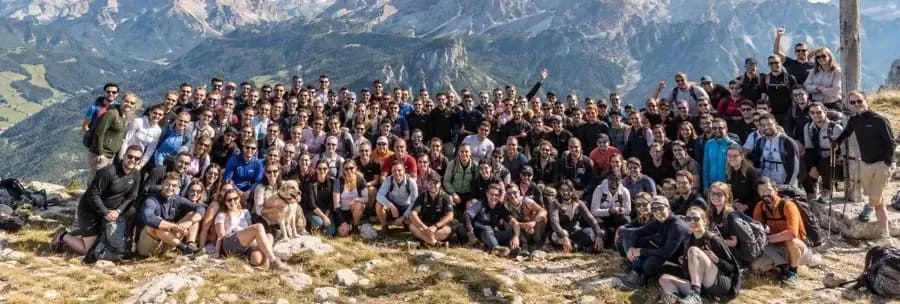
Team building with eight people is easy. You sit around a table, play something, talk. Team building with a hundred is a different job. Instructions need to reach the back of the room, nobody should wait twenty minutes for a turn, and the quieter people should still feel included.
This guide is for anyone organising team building for a large group: a company day, a sales gathering, a retreat or a conference with a social programme. It starts with what makes large groups different, then goes through twenty activities by type, and ends with a short list of practical details that make the day run smoothly.
What changes when the group is large
Four things change as numbers grow:
- Time. Everything takes longer: explaining, moving, setting up, finishing. Activities that take 20 minutes with ten people can take an hour with a hundred.
- Space. You need rooms or outdoor areas where people can split up and still hear the facilitator.
- Participation. In a big group it is easy for people to disappear. Good activities give everyone a role.
- Mix. People come from different teams, offices and backgrounds. Many will not know each other, which can be the main benefit.
The best large-group activities share a pattern: people work in small teams of five to ten, inside a larger shared experience, so that each person has a part to play while the whole group still feels like one event.
Before you pick: five questions
- What is it for? Getting to know each other, solving a problem together, celebrating, easing into a working session.
- How long do you have? An hour, a half day, a full day.
- What is the setting? Indoors, outdoors, at a hotel, in a city.
- Who is coming? Mixed ages, abilities, languages. Anyone who cannot take part in a physical activity should have an equal role.
- What happens before and after? A team activity works best when it fits the day around it.
Collaborative and creative
These work well when you want people to build something together.
- Build a shared project. Teams create a product, a campaign or a piece of art from a set of materials, then present it to the group.
- Group storytelling or film. Each team makes a short scene or video around a theme, and the whole group watches the result.
- Collective art. Teams each paint or assemble part of a larger piece that comes together at the end.
- Design challenge. A short brief such as "design a welcome for a new colleague" for teams to answer in 30 minutes.
- Music or rhythm session. A facilitator leads the group in making music together, with no experience needed.
Competitive and game-based
Good when you want energy and laughter, and the room is happy to compete.
- Quiz night. Teams answer rounds on any theme from company history to general knowledge. Scales easily to a very large group.
- Game show format. A live host runs rounds of tasks and questions, with teams scoring points.
- Treasure hunt. Teams solve clues around a venue, a campus or a city, with a final meeting point.
- Relay challenges. Short physical or mental tasks passed from person to person in a team.
- Escape-style puzzles. Teams work through a set of puzzles together. Offer many copies of the same puzzle so teams can run in parallel.
Active and outdoors
Good for energy, fresh air and a break from screens.
- Outdoor games day. A set of stations with different challenges, teams rotating around them.
- Orienteering. Teams navigate between points with a map, which suits open spaces and parks.
- Sports tournament. Simple formats such as relay, tug of war or beach games, with mixed teams and a relaxed tone.
- Walking or hiking in groups. A guided route with stops, for groups that like to talk while they move.
- Water or adventure activities. For venues with suitable facilities and a provider with safety experience.
Purpose and shared experience
For groups that want the day to mean something.
- Charity build or pack. Teams assemble items such as kits, bikes or meals for a good cause.
- Community project. A day of volunteering with a local organisation.
- Cooking together. Teams prepare a part of a meal that everyone then eats together.
- Learning from a local craft. A workshop in something that belongs to the place you are visiting.
- Shared dinner with a twist. Seating plan, conversation prompts or a short game that helps people meet someone new.
How to choose the right type
| If you want | Look at |
|---|---|
| People to meet someone new | Cooking together, shared dinner, mixed-team quiz |
| Energy and laughter | Game show, relay challenges, outdoor games day |
| A sense of achievement | Build a shared project, treasure hunt, charity build |
| A calm start to a working session | Storytelling, collective art, music session |
| Something that gives back | Charity build, community project |
Many events combine two or three: a short icebreaker, one main activity and a shared meal.
Making it work in practice
Divide people thoughtfully. Mix teams, offices and seniority. Decide in advance how teams are formed, and tell people where to go, so that the first fifteen minutes are not spent sorting groups.
Use a facilitator. One experienced person at the front and several helpers in the room make a big difference to pacing and tone.
Plan the space. Check sound, sightlines and movement. Have a backup if the weather changes.
Make it inclusive. Offer ways to take part that do not depend on physical ability, language or confidence. A role such as scorer, photographer or storyteller can be as important as the main activity.
Keep it short and varied. Aim for activities that last as long as people are enjoying them, then stop.
Think about food and drink. Breaks, dietary needs, water and time to rest.
Leave time to talk. The conversations around the activity are often what people value most.
Check the details. Registration, travel, accessibility, insurance and safety, especially for outdoor or adventurous activities.
How we approach team building at Always Friday
We are a tech-enabled event agency. For a team building day or a larger programme, you work with a dedicated event manager, who handles sourcing, negotiation and coordination through to the event itself. Behind them is our platform and a network of more than 10,000 vetted venues and suppliers, with preferred supplier rates.
Registration pages, invitations and guest management sit in the same place, and you receive one invoice, with supplier management in one place. This works for a half-day activity as much as for a multi-day retreat, and for groups of any size.
We organise People events, Sales events, Marketing events and Executive events, with hubs in Milan, London and Barcelona, and organise events globally.
If you are planning team building for a large group and want to see what is possible, you can share your brief in our AI event planner.
Frequently asked questions
What are some good team building activities for 30 people or more?
Quizzes, treasure hunts, game show formats, cooking together and building a shared project all work well. Divide the group into teams of five to ten so everyone has a role.
How do you run team building with a very large group?
Split people into small teams inside a shared event, use an experienced facilitator, plan the space and the timing carefully, and give each person a clear role.
What is the difference between team building and team bonding?
Team building is a planned activity with a goal, often about working together. Team bonding is the connection that develops between people, planned or not, through shared time and experience. Good team building leaves room for both.
How long should a team building activity last?
It depends on the format. A short icebreaker can take 15 to 30 minutes. A main activity often takes one to three hours. A full-day programme can combine several.
What are some good team building activities for executives?
Strategy-focused workshops, a shared problem to solve, a cooking or outdoor activity that takes people out of their usual roles, and a dinner with a prompt for conversation.
How far ahead should we plan?
For large groups, plan at least a few months ahead, particularly if you need a venue or an external provider. Smaller or in-house activities can be arranged faster.